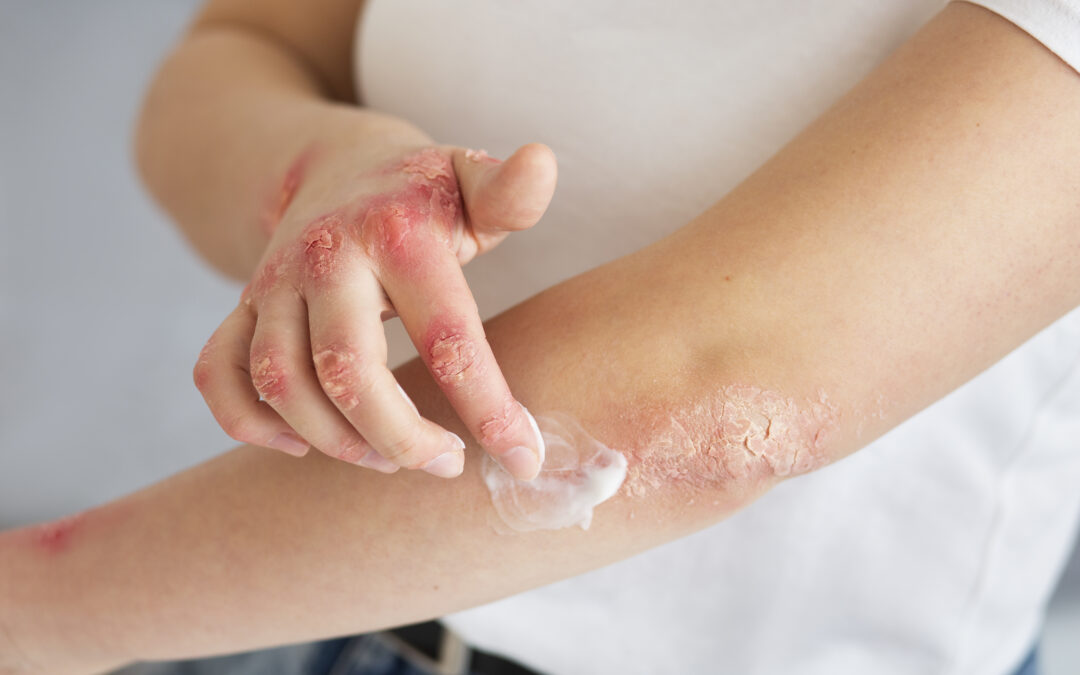
Your doctor will treat psoriasis by trying to clear the lesions from your skin. The treatment prescribed for you will depend upon your type of psoriasis, where it occurs on your body, how severe it is, your age, and your medical history. Your doctor will usually give topical medications for mild to moderate psoriasis. These medications include:
- Emollients (moisturizers) and lubricants.
- Steroidal creams (cortisone).
- The antipsoriatic drug anthralin. • Antifungal medications.
- Antibiotics.
- Phenol (a caustic compound generally used as an antiseptic).
- Sodium chloride.
- Various coal tar preparations.
- Vitamin D3.
You might be told to use these treatments alone, in combination, or with ultraviolet light (UVB). Exposure to sunlight helps clear psoriasis for some people. If you have moderate to severe psoriasis, your doctor will usually prescribe one or more of the following:
- Topical medications listed above for areas of mild to moderate psoriasis focused on control of the symptoms and prevention of secondary infections.
- Ultraviolet B light (UVB).
- PUVA therapy (a combination of psoralen-a chemical that makes the skin sensitive to light—and ultraviolet A light).
- An oral or injected immunosuppressive or anti-inflammatory medication, such as methotrexate (MTX), corticosteroids, or cyclosporine.
- Oral vitamin-A-derived antipsoriatic medications (Tegison and Accutane).
If you have severe psoriasis, you will be given more toxic treatments, such as the systemic drugs hydroxyurea or 6-thioguanine (see Chapter 3 for more information about these treatments). Traditional treatments can stop working for you in the middle of therapy, and you might have to change to another treatment. Many of the topical, oral, and injected treatments given today for psoriasis can cause big problems for you. They can make
WHAT IS THE DIFFERENCE BETWEEN PSORIASIS AND OTHER SKIN PROBLEMS?
There are other skin disorders, such as eczema, that also cause skin swelling, skin eruptions, pain, tenderness, and redness. The most obvious sign of psoriasis is excessive shedding of skin cells. These skin cells look like silvery scales on top of the red patches on your skin. Take a look at your fingernails and toenails. If you have psoriasis, you will probably find tiny pits on a few of your nails. Other conditions that can affect your skin are listed below so you can compare your unique condition with these symptoms.
Eczema
Eczema is an inflammatory condition of the upper layers of the skin. Some doctors call it atopic dermatitis. The part of your skin affected by eczema will have patches of blisters, redness, scabbing, and scaling and usually itches. More severe lesions will be redder. The blisters may start weeping fluid. The skin will become thicker after you scratch or rub the patches. Your skin in those areas will be dry.
Rosacea
Rosacea is a flushing or subtle redness on the cheeks, nose, chin, or forehead that comes and goes. If it gets worse, bumps and pimples called papules and pustules appear, and small dilated blood vessels may become visible. The nose may become red and swollen from excess tissue.