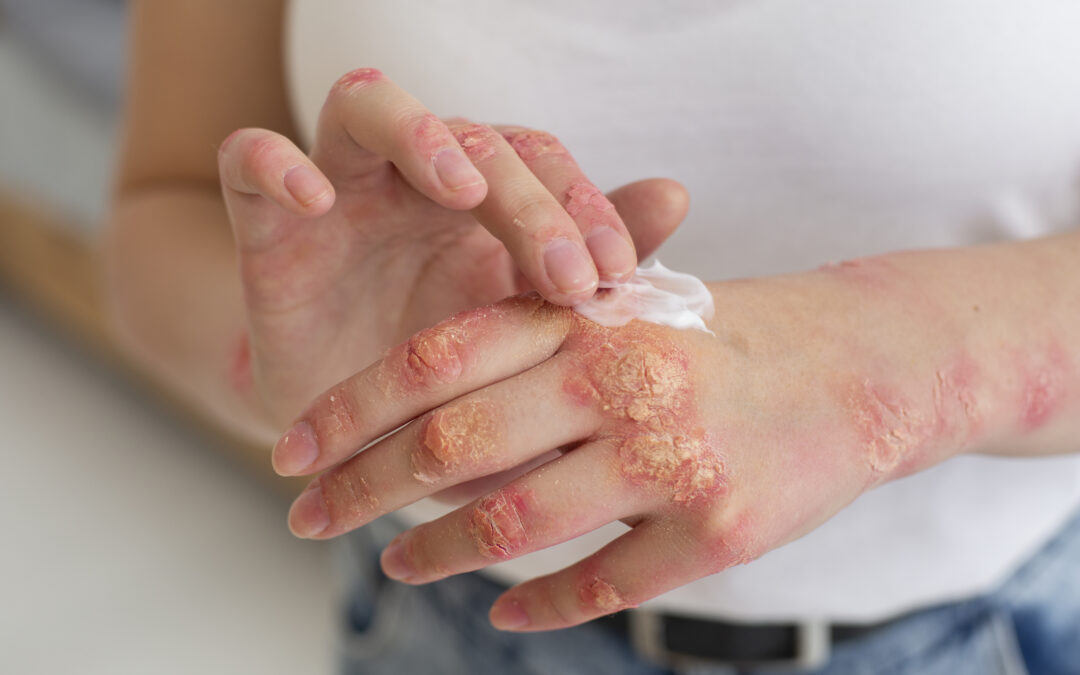
It starts with a little redness on your elbows, face, or knees. No big deal. Then, you notice it feels dry and is starting to flake. You even sometimes find yourself rubbing or scratching the spot. You’ve got your first date since starting college this Friday night, and that mess on your face and elbows has got to go! You try putting some moisturizer on the spot and rubbing off the scales, but in the morning, the scales are back, and the spot is redder and bigger. Everything you try just seems to make it more noticeable. Just when you think things can’t get worse, you notice another red spot. You’re becoming desperate—desperate enough to call home and ask mom and dad for help. “Dad! I’ve got this horrible-looking flaky red spot on my face, and I can’t make it go away. I’ve tried everything. Any ideas?”
Have you eaten any bacon lately?” “Well, yeah. The school serves breakfast every morning in the cafeteria, and I’ve been having some every morning. It’s really good. I wonder why Mama never fixed it at home. Why?” “I’ve got psoriasis, and eating pork makes it worse. You’ve got psoriasis now, so don’t eat any more bacon. It will make it worse.” “You mean I got this mess from you? Why is it starting now?” “Yes, it is hereditary. Mine started around my late teens, too. Your grandmother, my mom, had it too. Welcome to the Drennan clan.” “Thanks a lot, Daddy. So, if I just quit eating bacon, it will go away?” “No, that will help, but you still need to go see a dermatologist to get something to put on it.” The dermatologist peered at my scaly patches, then grabbed his prescription pad. He handed me the prescription for some cream for the spots and some sample tubes. “Will this make it go away?” “Yes. But you can’t just use this forever. It is a steroid and will make things worse eventually if you use it too long.” “How did I get this, and how can I get rid of it?”
WHAT CAUSES PSORIASIS?
Psoriasis is a slow and progressive condition that usually first strikes in the teen years, affecting the skin, nails, joints, and one’s overall feeling of well-being. It flares up when you become overstressed, when your skin is injured, or when you develop an allergy. You may notice more scaly spots or that those you have might get worse after you have a systemic infection, like strep throat, or other illness; injure your skin; take a medicine or get vaccinated; deal with a
lot of stress; or drink alcohol. Research has shown a link between this condition and the body’s ability to properly use fat and create necessary breakdown products. The body needs the breakdown products of fat to lubricate your skin and give you energy. Your body also needs to make the right amount of the right type of hormones to keep inflammation down and your immune system running properly. When your body doesn’t produce enough of the proper hormones, your skin suffers. We will discuss this in more detail in Chapter 2.
Symptoms of Psoriasis
Psoriasis is a symptom of any of a variety of conditions affecting the body, including allergies, disorders of the immune system, and disorders of the liver. In order to identify psoriasis to find the underlying problem, you must know its symptoms. They include:
- Dry and/or red skin, usually covered with scales.
- Bumpy patches of skin with red borders.
- Pustules, cracked skin, itchy skin, small scaly dots on the skin.
- Aching joints. • Pitted fingernails and toenails.
- Burning and itching eyes.
WHO IS AFFECTED BY PSORIASIS?
As mentioned earlier, psoriasis is the second most common skin disorder in the world. It afflicts millions of people worldwide, including more than 6 million Americans. It first strikes most people between the ages of 15 and 35, and 150,000 new cases are diagnosed each year. Sometimes even young children are affected shortly after birth. As mentioned before, there is a very high tendency for it to be shared among blood relatives. Psoriasis can strike anyone, yet it is most frequently found in Caucasians. Men and women are equally likely to be affected.